Exhibition | ÁGUA DE MATAR PASSARINHO
- 6 days ago
- 4 min read
October 04th to 25th, 2024

Exhibition view. Photography: Susana Rocha
SOLO EXHIBITION:
Thomas Szott
TEXT:
Gabriel Ribeiro
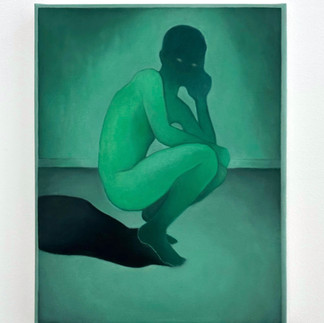
I woke up with a metallic taste under my tongue, as if the night had left invisible traces on my body. With my eyes still closed, projected on my eyelids, scattered spots of color movedlethargically, forging a choreography of uncertain contours. Fingers stretched out from the cuff, testing the limits of my skin, touching the fabric of the bed, as if trying to reorient thesensation of the body itself. This brushing — skin against skin, skin against surface—awakened something deeper, a subtle friction that triggered a vibrational wave. In Thomas Szott’spaintings, there is this electric atmosphere; the slightly fuzzy, suede-like skin coats an enigmatic cast, where the figures appear gradually, without immediate features. They are exhibitionists, but invariably incognitos; like timid peacocks —sometimes exuberant, sometimes curling inwards—engaging in a sort of Platonic pre-language. They keep theirdistance but also maintain fixed eye contact. These are bodies that seem lit from within through mechanisms of self-luminescence, indicating some interest in the possibility ofactivation, mating, or simply contact. In Jealous All The Time (2024) The eyes staring at us are as piercing as those of a green panther, but the prostrate body resembles a child’s: theystir suspicion, even potential flight, but at the same time, they ask for comfort.
Thus, ÁGUA DE MATAR PASSARINHO gives the impression of arriving in the aftermath of an event where traumatic memories linger. However, there is a sense that we are observing it from the defensive distance of reinterpretation and remembered time. Bottles usually made of glass—fragile, dangerous, sharp—here appear regurgitated in textiles, in anapparent attempt to domesticate the act of remembering. It is as if there is finally emotional readiness to revisit them, through this retrospective lens, and through the touch—both soft and rough—of felt. In this way, felt emerges not only as a substitute for other presences but also as a strategic raw material that favors the cutting of fabric and memory, revealing thatmemory, in the end, is plastic. The fabric is then cut, perforated, and folded as easily as one dreams, or as easily as one cuts a sheet of cardboard; a method that not only brings Szottcloser to an emotional experience of cutting and pasting but also allows for the outlining of letters and punctuation marks, which acquire confessional and cathartic power.
The confession arrives in the form of fragmented, spasmodic, and sometimes chaotic memories, that seem to long for some more tabular pragmatism; as we find in Bad At Love(2024); a sort of patchwork- banner, organized in such a way that each cell provides the opportunity to process some experience of love and heartbreak, for oneself or for someoneelse. The specificity of the word, conversely, offers a loose- ended narrative, with infinite combinations between lines, columns, and passions. When we face the piece, we entersomething between a battleship board and a Love Bingo, oscillating at the crossroads between a trap and the path to the stars. The star, a motif that is at once simple when it twinklesin the sky, becomes hysterical when it adorns the clown’s face.
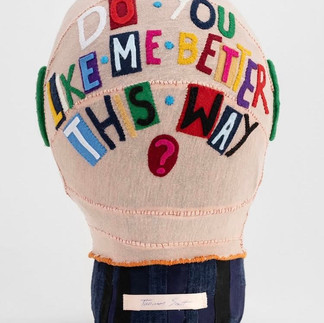
When I Put On a Happy Face (2024) is precisely the head upon which this behavioral tension is stitched, and where these feelings likely commune, intimately. A tension typical of theentertainer who delivers before the audience but falls into a deep internal abyss when they return home, one that opens from the circumference of their own navel. The sensation is of a continuous cycle, where pain is hidden by the spectacle, only to return with renewed force in the silence of solitude. Yet the clown also carries a particular sweetness, and above all, a unique ability to turn risk into momentary healing: their performance is the purest spark between sweat and tears, between exposure and concealment, between beginning and end. Andthe next day, encore. Send In The Clowns. It’s Showtime!
This tendency towards excess—which seeps through the body’s cracks by osmosis—seems to be a symptom of a turbulent management of the impulses to give and withhold, to veiland reveal, which conceptually permeates the exhibition but is also anchored in formal points in Szott’s practice. ÁGUA DE MATAR PASSARINHO thus erupts as a kind ofirresistible poetic betrayal, as the composition of this liquid seems to provoke the contradictory effects of an arsenic-elixir. It is a promise of antidote, but one that is secretly distilledfrom one’s own poison.
And suddenly, like the flock of birds that breaks the sky heading east in Nós Que Tanto Sonhamos (2024), there is a call that echoes; not as an escape, but as a way of being in motioncollectively. The painting reveals a choreography of open wings, a collective flight that does not seek to escape what was left behind but the expansion of the possible, a journeytowards the unknown, where the trajectory is not subterfuge, but continuous flow. Each wingbeat is a gesture of shared care—for the air, for the space between bodies, for the horizonthey draw without ever really reaching it. There is also a promise here. The sky, tinged with a warm red-orange, suggests more than a simple dawn or dusk; it suggests that time isthick and that the future is always coming, already mingling with the past and the present.






Comments